The Rise of the Awakening Consumer

The Rise of the Awakening Consumer
Seven Rules to Influence Today's Most Influential Consumers


'They are educated, ethical and influential. They do their homework, and can mobilize with rattlesnake speed. They are Awakening Consumers, a large and growing group of people who are awakening to the realization that they can bring about social and environmental change simply by selecting one brand over another. They are driving the sustainability movement, and represent a tremendous opportunity for business around the world.

Contained in this book are seven of the most significant trends in the business world today. They are shaping - and being shaped by - Awakening Consumers' behavior in the marketplace. The seven trends are accompanied by seven rules for how marketers should govern themselves in order to make their way into the hearts and minds of Awakening Consumers everywhere.

Here are the collective thoughts and insights of Green Team editors, staff (both past and present) and friends. Considering that it was Green Team who identified and labeled the Awakening Consumer in the first place, there is no better guide to winning over this remarkable group, and reaping the rewards of doing so.'

______________________________________________

I am proud to say I compiled, edited and co-wrote much of this wonderful book with Green Team, the pioneers of sustainability communications and thought leaders in the green space. Please visit their website for more information and to order a copy for yourself.

World's Most Ethical Companies


Ethisphere have compiled a list of the world's most ethical companies for 2011.

With reference to my previous post in which I consider competition in the green space and Coke and PepsiCo, PepsiCo - according to Ethisphere - are in the lead.

The Pepsi Refresh initiative is going to be tough to top.

Competition is good for green

Coca-Cola and Pepsi have long dominated the soft drink industry. As new markets sprout, one had led and the other had followed. The green market is blossoming and both have made huge social and environmental commitments. Competition has proven good for green.

Coca-Cola made news with a plastic bottle made from 30% plant-matter. Pepsi's Refresh campaign has broken records in donations to various social programs.

Now Pepsi has broken ground once again, competing directly with Coca-Cola, with an announcement of a bottle made entirely from plant-matter.

It would be wonderful to compile a list of examples where direct competitors are fighting to better each other in the green space. Please comment with any examples that come to mind.

Your move Coke...

Don't ignore the worm in your iPad

We've been choosing the bad apple since Adam chose to pick the proverbial apple in the very beginning, sending us all into a world of eternal sin. Today, Apple purchases are steeped in sin. And today, we still have a choice. In Our Great Sin, Devin Coldewey offers three approaches for an individual wishing to confront their unethical purchases:

* Claim moral status and adjust actions
* Claim moral status and justify actions
* Claim no moral status and continue actions

I think we can look at this issue both individually and collectively. As an individual it may be possible to - with some degree - boycott a technology firm and live without their gadgets. Having adjusting his actions, he can take the moral high ground and feel good about himself and his ethics in action. But it's not a solution. A collective boycott, what Coldewey calls 'Consumer intervention', is necessary to affect change. And only through a collective boycott can we begin to address some of the problems (relating to the economics of Chinese-manufactured goods) in other parts of the world, such as high unemployment and the growing rich / poor divide.

An almost perfect alternative to boycotting is simple: We pay a much higher (and fairer) price. But let's be honest, this isn't going to happen. Sadly Coldewey is right, we simply aren't prepared to pay a higher price for the knowledge that it is an ethically sound product we've just paid for. In reality though, we are paying a far higher price but it's not coming out of our purses. We're paying to live in a world where people are living and working in subhuman conditions, where animals live out the saddest existence only to be killed in the most inhuman ways one could imagine, and where our natural world is being raped for any and everything we can possible find a use for. We are paying for it.

I don't know how to spur a collective boycott. As Coldewey infers, today - with social media and the Internet - we are capable of creating mass awareness for any cause we like but it's not enough to bring about mass action. As an individual, the best we can do is chose our battles, do what we can and hope the next person is waking up and doing the same. But importantly, we should do this without lying to ourselves and trying to justify our bad choices. Don't ignore the worm in your iPad.

We should be boycotting Apple and finally holding them accountable. Their sustainability record is ghastly and they don't care. Apple is cool right now and people are buying up their gadgets faster than their Chinese sweatshops can make them.

Every purchase comes with a number of choices, from cost to quality, from brand to origin etc. Sure, many of us cannot afford the luxury of choice. Of you that can though, ask yourself: What is the real cost of that apple or that Apple gizmo? And can you afford it?

Who wants sustainability?


Kids are saying it in their classrooms, young adults are saying it in their homes, and CEOs are saying it in their boardrooms, it’s all over the Internet, television, radio and newspapers. Everyone is saying ‘sustainability’!

What does this mean for the word ‘sustainability’ and the world of sustainability?

The etymology of words is something I find fascinating. Not only do you discover a word’s origins, you often discover its original meaning, something quite different to the meaning the word holds today. I recently read a New York Times article which discusses this cool Google Labs tool: Books Ngram Viewer which lets you search for any word or phrase in Google’s huge online database (Google Books) of over 500 billion words and phrases in books published between 1500 and 2008. Check it out.

I did and used it to search the use of ‘sustainability’ between 1900 and 2008 and here’s the result:

(Click to Enlarge)

Right now I’m still trying to figure out what the percentiles mean but the graph speaks for itself. To say the least, sustainability has become a very popular word over the last two decades. In a different article entitled Is Sustainable Really the Jargoniest Jargon? Sandy Skees concludes that, in the case of ‘sustainable’, it’s not so much the overuse of the word but its misuse that has watered down the meaning of this word so much.

I followed up my Google Books search with a much more complicated search for a simple definition of ‘sustainability.’ I’ve settled for the opening sentence from Wikipedia: ‘Sustainability is the capacity to endure.’ The million and one other definitions available relate to business and lifestyle choices. As we all know, sustainability is big business!

We’re killing our planet, we’re running out of the precious resources we need to survive and we’re in a recession. We have so many reasons to welcome the era of sustainability, and embrace our ‘capacity to endure.’ What was happening before this era though? Oh yes, we lived as we pleased during what was probably humanity’s most prosperous era. Business was good too! But while many of us – consumers and businesses alike – are now willing to endure, many do not want the era of prosperity to end. That wouldn’t be so bad either! Perhaps my choice of meaning for sustainability is a little biased in favour of this argument but it highlights a point: Many people associate sustainability with hardship and personal sacrifices like recycling, driving a fuel-efficient car, eating seasonally, the list goes on.... Moreover, for this group the environmental, social and economic (or green) benefits of living more sustainably are not worth such sacrifices.

This last point leads me to a popular rule of thumb in green marketing: ‘Market the primary benefits before the green benefits.’ In other words, first show the consumer that the (natural, environmentally safe, recyclable) drain cleaner can in fact unblock a drain before showing that it’s natural, safe and recyclable. That done - and while the conscious consumers seek out this product for its green benefits – those unwilling to endure possible hardships might still give it a try. This marketing rule of thumb is moving green products off shelves. But I would argue that, long before the 1990s and rise of sustainability, this rule has long been in use. For example, no matter how far we look back, motorcar adverts haven’t boldly claimed that the car works! To be competitive the ads have to highlight its additional features that set it aside and attract customers.

I believe that innovation in the world of sustainability must, and is, taking this rule of thumb to its final conclusion. Not only will products provide both the primary and green benefits, they will compete with their non-green competitors in other categories too: Imagine an electric car that is not only eco-friendly and works but is as safe, powerful and luxurious as any on the road! Such a car will attract both those willing and those unwilling to endure.

What will the word sustainability need to endure through all this? Will it become watered-down even further? Skees defends the (over)use of the word and the significance of its current meaning for humanity and the planet. She also offers a solution: We need more words to ‘represent all of the concepts, ideas, categories, approaches and disciplines that this one overused word has been burdened with carrying.’ This may help us to better articulate ourselves without misusing the word or warping its meaning but it won’t get the green products in the shopping carts of the unwilling consumers. To accommodate everyone, perhaps the world of marketing and advertising will orchestrate the redefinition of sustainability. Perhaps, in a hundred years, it will no longer mean ‘to endure’. Then, perhaps… we will all want sustainability.

Introduction to the Sustainable Storage Space

Good day,

This is a space where we can share, and ultimately store, ideas; articles; links; and interesting tidbits about the age of sustainability! While it is really exciting and inspirational, the amount of information available is unmanageable. I'm hoping that this space will help us to navigate the web and collect the cool things we find.


For example, a colleague just sent me this and I want to share it too:

Colenso BBDO, a Kiwi ad agency, cleaned up the sidewalks of Auckland with the 'Beautify your City' campaign. The dull, bulky black rubbish bags were replaced with coloured bags transforming the piles of rubbish into bushy hedges and flower beds!

It may not reduce the amount of rubbish we create but it looks great and it may make us think twice about what we throw away.

Check it out: Heart of the City/Auckland Council – Beautify Your City: After Heart of the City Rubbish Bag


Any thoughts?

A sad / funny story from home (Durban, South Africa)

Having been away for a few years now I enjoy the oddbits that family and friends send from South Africa. At times, I've used this blog to share stories from home. Sadly, they're mostly news of the worsening state of affairs in South Africa and Zimbabwe. I hope that the world cup brings only good tidings. This, on the other hand, could be construed as indicative of the worsening state of things in Durban or just as a comical tale. I enjoyed it for its humorous side but it is, I guess, pretty sad.

My aunt shared this story with me. I haven't bothered to edit her email as she's a good writer. Here is the story:

________________________________________________

Yesterday I went to the library and was waiting outside for my friend to pick me up and struck up a conversation with another lady doing the same. Most conversation is centered around World Cup at the moment. This lady told me a really funny story.

Her son has a small courier business in Durban and was lucky enough to be granted a contract to do deliveries to and from the airport of any documentation pertaining to the World Cup. As he is a one-man business his godmother offered to do the driving for him and for this she needed a special permit. So she went down to her local Police Station to fill in the necessary forms. She was told that it would take +/- 2 weeks to process. She went back 3 weeks later and when she walked in there was just one lady cop behind the desk talking to another male who, she presumed, was also a cop although in plain clothes. The lady cop did not move off her chair but told the woman that it would still be another 2-3 weeks before she could collect her permit! (2 weeks now becomes 6!.) The woman decided not to make waves and to come back again in 3 weeks time. After the 3 weeks she again went to the Police Station - this time there was nobody behind the desk so she took a walk down the passage and found a cleaner in one of the offices - she recognised this cleaner as the guy who she thought was a plain clothes cop! The conversation between them went something like this:

"Ah madam, you back again?"
"Don't I recognise you?" says the woman.
"Yes madam, but you know, the people in this office are so bloody stupid!" and with that he walks over to a filing cabinet and takes out a whole sheaf of papers.
"Just look through these papers, madam, and see if you can find yours."
She does this and lo! and behold, her permit is there! The cleaner then takes it from her, walks round to the desk, opens one of the drawers and takes out the official stamp, stamps and signs the document and hands it back to her!!
"I told you madam, these people are too bloody stupid and lazy. I can do their job better than them. The only reason I can't do it officially is because I did not pass matric!"
"Won't you get into trouble for doing this?" says the woman.
"Who is going to know?" says the cleaner "and now you have your permit!"
________________________________________

I don't want to judge anyone, yet alone a police officer, and even more so a South African police officer, knowing what they have to deal with on a daily basis but... when the cleaner is undermining the authority of the police officers like this, you have start asking questions. Personally, I find this tale funny because I don't find it at all surprising. For a South African, this is a typical story, and I guess that's what makes it sad.

I just hope that the successes of the world cup aren't coupled by stories like these. More so, I ask any foreigners that may be visiting my beautiful country for the world cup tournament to go prepared, be vigilant, take care and don't be a victim. I don't want to read anymore sad stories!

A Purely Good Act?

Today I cleaned Liane's apartment! Why am I cleaning her apartment? As I cleaned I pondered this question, or should I say, while I cleaned I had the chance to ponder this question - when else could I ponder this?

...Or: while I cleaned I enjoyed pondering this thought! The obvious answer and one that isn't entirely false on this occasion is that I'm doing it to be kind to my girlfriend. But this is not the entire truth. Sadly, I somewhat enjoy cleaning! Furthermore - let me be honest - I'll also enjoy (derive pleasure from) Liane's reaction to the clean apartment.

If the sole purpose of my cleaning the apartment was to please Liane then I would claim that I am doing a purely good act (implying that I don't derive any pleasure at all from the deed) but I enjoy the cleaning, I enjoy the cleanliness too(!), and I'll enjoy Liane's reaction. I can't claim this is a selfless act, a purely good act.

If we judge the act from a deontological perspective we could claim that the act of cleaning was good in itself, without regard for my motives. But, from a teleological perspective my motives are arguably tainted by self-interest regardless of the act itself.

Considered universally, can we truly claim that any act is truly selfless - a purely good act? No matter how selfless an act, is it not tainted by some self-interest, some personal gain, albeit just the satisfaction for doing a good deed for someone else?

What then is a Purely Good Act?

I'm dropping name again - Morgan Riekert - the artist

I began my last entry by stating that I'm not one to drop name only to drop name, that of my writer friend T.A. Sedlak.

Today I'm dropping another name: Morgan Riekert, an up and coming artist based in Durban, South Africa. I remember a few years back, I witnessed his humble roots, his first sale: Gaia which is now hanging proudly on a wall of its happy owner in Washington DC (as seen below).


Below are some of my favorite pieces which also demonstrate his depth and the variety of his work. His work is selling faster than he can paint at the moment, and each time I visit his website I more and more impressed by what I see. Please visit his website - The Spiral - and check out the amazing work of this prolific artist.


As said, Morgan is based in Durban but can ship artwork overseas. His contact details can be found on his website as well news about new work and gallery exhibitions. And if you have something special you'd like painted he also does commission work, so please contact him to discuss it.

T.A. Sedlak - A soon to be literary success...

I'm not one to drop name (not that I get many opportunities) but I am one to take any opportunity to spread the word when good friends are finding great successes.


My friend Troy is on the cusp of literary success. His first novel, Anarcho Grow, is due for release in the Fall. Please take a moment to check out his website where you can read his bio, follow some of the marketing events leading up to the release date and even read the first chapter of the novel.

Troy was living here in Korea last year while he worked away on this book. I've witnessed the blood, sweat and tears he has poured into this work and the realisation of his dream.

Please visit his website, read the first chapter if you get a chance and of course...buy the book when it's out.

Budae jjigae - a response to so many...

This entry is, for me personally, truly befitting the title of my blog - The Same but Different.

Budae jjigae (army base stew) is a famous Korean dish. But unlike Kimchi which is gaining immense popularity worldwide for its taste and health benefits, budae jjigae is famous for its strange origin and, quite honestly, sad story.


This dish came about soon after the Korean War when meat was a scarcity. The Korean people were largely dependent on surplus foods supplied by the US Army which primarily consisted of hot dogs and tinned spam (do you get untinned 'fresh' spam?). These meats were combined with red bean paste to create an almost traditional Korean soup. Due to the scarcity of all foods during these dire times any other ingredients available were added to 'beef up' the soup, including ramen noodles, beans, ground beef, peppers, onions, tofu, kimchi, garlic, and I'm sure, any other vegetables available. The sadder, almost perverse, version of this story that I have heard is that the impoverished Korean people were often forced to scavenge the bins of the US army bases for food, much of which went into this 'lucky packet' dish.

This is the sad story of Budae jjigae. But today, this remains a popular dish and many foreigners - encountering the dish for the first time and learning its humble beginnings - beg the question, 'If the Korean people are not impoverished anymore why do they continue to eat this dish?' It's a fair question and, after enjoying this very dish the other day in the school cafeteria, I answered the question, though my answer is arguably more personal than general in application.

I did not come from the wealthiest of households and often the fridge was on the bare side. What amazed me on many of these occasions was how my mother was able to pull out the two remains vegetables, an egg or two, a bit of rice from the cupboard and a few herbs and spices, and put together a nutritious and delicious meal that left me with a full belly and a content smile! And while I sat contemplating this the other day after lunch of budae jjigae (with a full belly and a content smile) I realised that I was missing my mom's cooking, and not her amazing curries but her budae jjigae!

My answer to the question, that in my experience has left many foreigners inconclusive, why do the Korean people continue to eat this meal? Today budae jiggae has little to do with its sad story and more to do with the fact that it's a tasty meal enjoyed by all.

Personally, the story and love for this meal in Korea is both the same and different as my love for my mom's cooking - a humble beginning but timeless taste!

Anyong-hi kyeseyo Pyeongtaek


Pyeongtaek City, South Korea

I began this blog entry a few days ago while I was still in Pyeongtaek, I have now made my move to Gwangmyeong. The blog started 'Two more sleeps in Pyeongtaek', I didn't finish it that night and the following day changed it to 'One more sleep' and now I'm still in the process of completing it, no more changes though...

One more sleep in Pyeongtaek. I have just completed my first year in South Korea and first year as an English teacher at Pyeongtaek Girls High School. This has been one of the most exciting, rewarding and intense years of my life. As a vagabond I don't have a home, home is where I rest my head at the end of each day so Pyeongtaek has been my home for this very interesting year. In two days I will move to GwangMyeong. Its just a hop and a skip of a move but thankfully I'll practically be in Seoul now so my life outside of school should become a little more interesting.

But this post is about Pyeongtaek! Pyeongtaek is a relatively small city. It is jam-packed with restaurants and bars but has little else to offer. So yes, I have done my fair share of eating and beering over the past year.

The best part of my time here has been at school. This week has been sad, having to say goodbye to all my students, some of which I've grown very fond of. Building up to my last week it was a mix of emotions and I wasn't sure how i would feel saying my goodbyes. I'm glad to say it was sad, it reflects how much I enjoy my work. Below are some photos and videos I've taken over the year and during the last week.
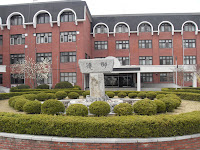
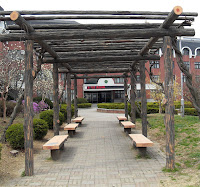
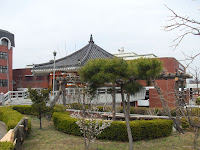


The view from the outside of the school and the hockey pitch

Last Thursday night was my farewell dinner, we went to a Korean BBQ place just across the road from the school as a few of the teachers had to go back to work after the dinner. I wasn't complaining - I love Korean BBQ...I'm South African! Little BBQs (braais) are the center piece of each table and the meat is brought in raw. I like being able to cook to meat myself, its then chopped up and everyone tucks in. The little sections of meat are then wrapped up in a lettuce leaf with some red pepper sauce and a piece of raw garlic - superb! Of course the tables are very low, you remove your shoes at the entrance of the restaurant and you sit on little mats of the floor. Koreans, having lived like this their wholes lives, are quiet content to sit for an hour or two with their legs crossed, us Westerners suffer though. It can be painful after a while. I'm getting better.
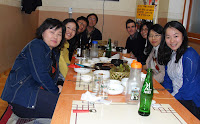
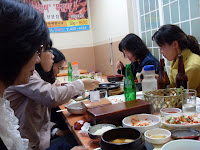
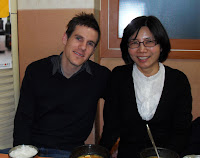
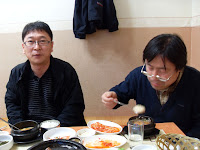

The the uppermost photo is (from left to right) Soo-Hyeong, Lucy, Koo, James, me, Mie-Hye, Jiwon and Jenny (many Koreans assume English names!)

On Friday I almost missed my final class because I had to say goodbye to the principle. I can count on one hand the amount of times I've actually seen the guy but respect must be shown so James and I went and had tea with him in his office. James was there to translate, the principle was friendly enough and I had time enough to say my goodbyes to one of my favorite classes. It was one of Koo's classes and they're quite chatty with me. And Koo is quite a joker...
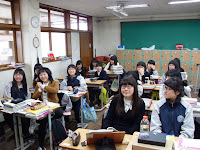
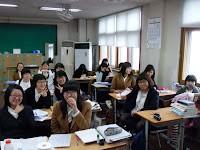
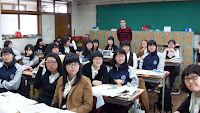


These are just some random photos and video to give you an idea of what it's like in class.

Below are some more random photos and videos taken during a Korean traditional music event in which our school and others in the area all played some tunes for our students! In truth I'm not the biggest fan of Korean traditional music. Most of it has a strange beat that I can't follow, the instruments are interesting though and I like that there are a lot of drums.
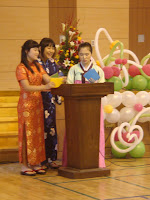
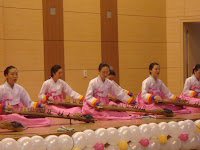
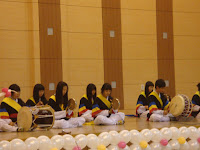


The annual sports day was a highlight and I laughed my head off throughout the event. I'm used to 'serious' and highly competitive sports days consisting of athletics in the winter and swimming in the winter. At Pyeongtaek High School its dancing! It answered a big question for me: Why, for weeks on end, we're girls dancing their free time away...why? This was serious!


After some sad goodbyes on Friday I was keen to liven my spirits. I met with my Canadian friend Joel (one of the last in the area) for some street food. Much of which I mention in this post is not particular to Pyeongtaek, as is the 'street food'. All over the country, in every city and even the smaller villages I have passed through, there are little tents dotted here and there and movable food carts (pojang macha), which all sell quite similar food and snacks, sometimes soju and beer. These tents are usually (wo)manned by an ajuma (an old married woman), a very friendly very old and very happy woman bustling with energy and warmth. This particular tent did not sell soju so Joel (a big soju fan) bought a bottle to bring along. To accompany our soju we ate gimbap (like sushi but wrapped in seaweed), ramen noodles and bokdo (a spicy rice noodle dish) - very yummy and very cheap!
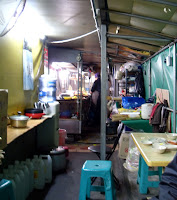
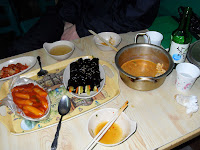

Hidden down a back allay. this is the ajuma's makeshift restaurant Joel and I visited Friday night. Much of the roof was tin and cardboard but the food was great!
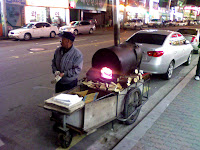


A few of the street carts dotted through town and the Korean version of biltong (beef jerky) - all from the sea!

The soju was quick and we headed downtown so I could take some photos of Pyeongtaek, I don't see me rushing back here but want to capture my first port of call in Korea! I got a few shots of the sights and sounds, the neon and the shadows and we found ourselves in the Pink Light District. These 'Pink Light Districts' are the same as the Red Light Districts we have in the West. Our mission was to sneak some photos but a bottle of soju, two tequilas and a White Russian later I was a wobbly, forgetful and stupid. I only got the one the photo before we chased out of the area by a pimp!
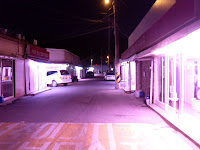

The story of these Pink Light Districts is very interesting and of course very sad. Like any prostitution in the world it is usually maintained through addiction. Here the addiction is plastic surgery and shopping and the girls get sucked in through credit card dept. The Pyeongtaek Pink Light District is one of the largest in the country and is the only one which has it's own union! If you wish to learn more click here...
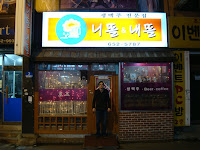


The splash of neon of the main road through downtown Pyeongteak, summer shopping downtown and me outside the first bar or 'hof' I visited.

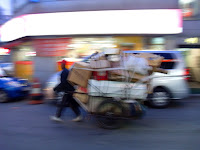
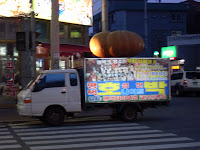
As said before, much of what I found fascinating or just different here in Pyeongtaek can be found all over the country. Two things I appreciated was the old folk who are constantly recycling and the small trucks that drive around advertising. The rear of these trucks are lit up with advertising and they'll have load Hangul (Korean) blasting as the slowly pass by.

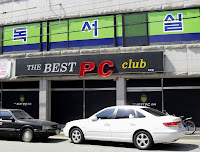
We're all aware of the level at which Asian youngsters are addicted to computer games. You may recall the story that hit the news about four years ago of the Chinese kid who died after playing online games for three days straight. It is a serious problem here, online gaming is a intricate part of the culture and PC Rooms (Pishi Bang) can be everywhere. Form my apartment there was at least twenty a five minute walk away. These are open 24 hours a day and are usually quite full of kids and adults alike.


This is Harmony Villa where I lived, the snow which I woke up to a few months ago and my Elvis Cuts, my hairdresser around the corner.




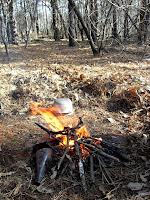
Not too long ago Joel and I tried to embrace all of Pyeongtaek and we walked down to a reservoir in search of something to do. We did what any man would do after being stuck in a city for a few months...made a fire!



After all said and done I will conclude that I was very happy in Pyeongtaek. That happiness was mostly found in school. Pyeongtaek Girls High is a great school with great students and co-teachers. Pyeongtaek may not have been the most exciting place to be but it served me well and will look back fondly on my time there. I met some great people and made a few friends. I hope that Gwangmyeong brings me as much joy. Tomorrow is my first day of school. I'm settled in my new apartment - photos and stuff to follow. Wish me luck in my new venture! Here are a few pics of my new home.